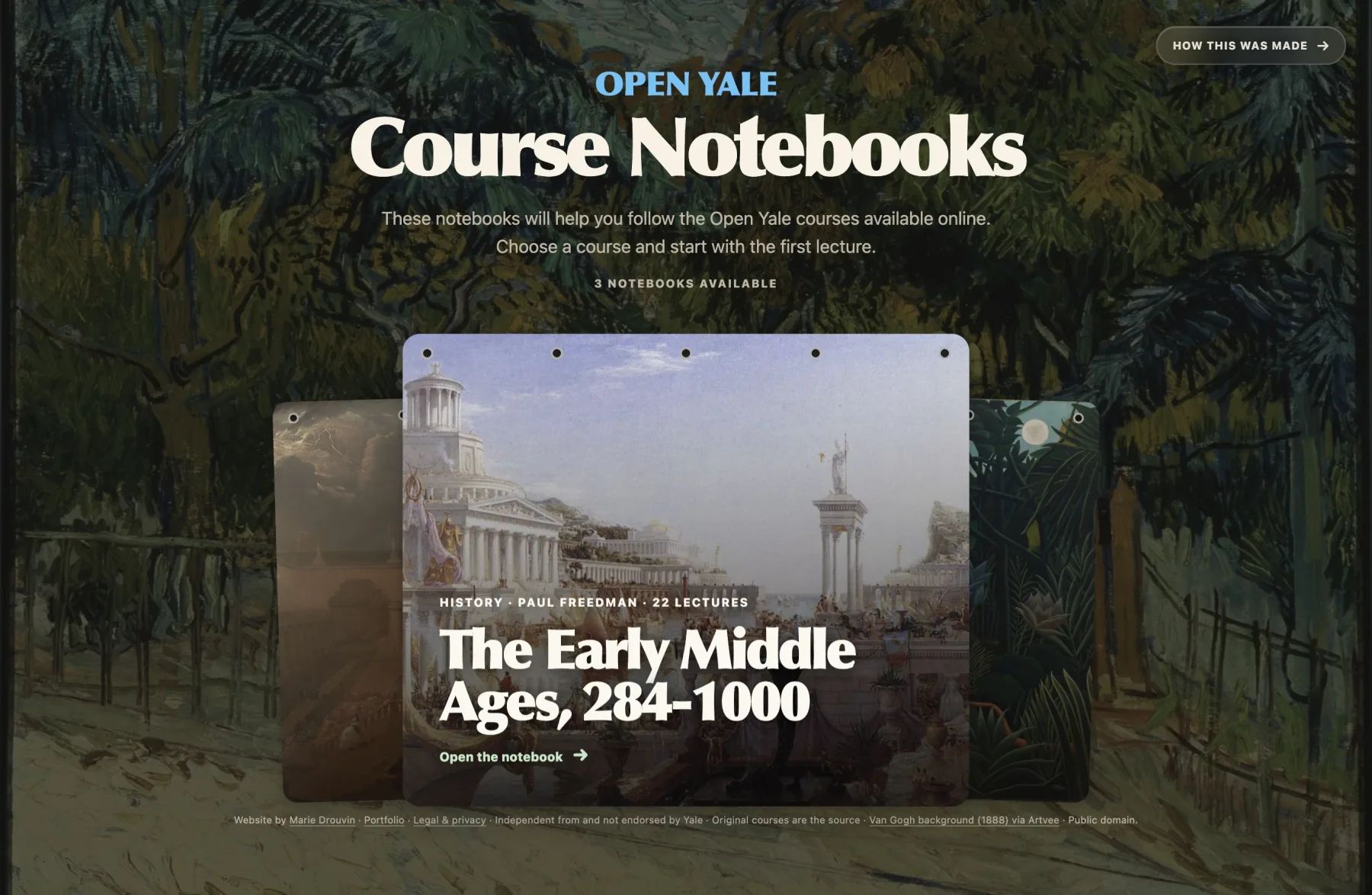
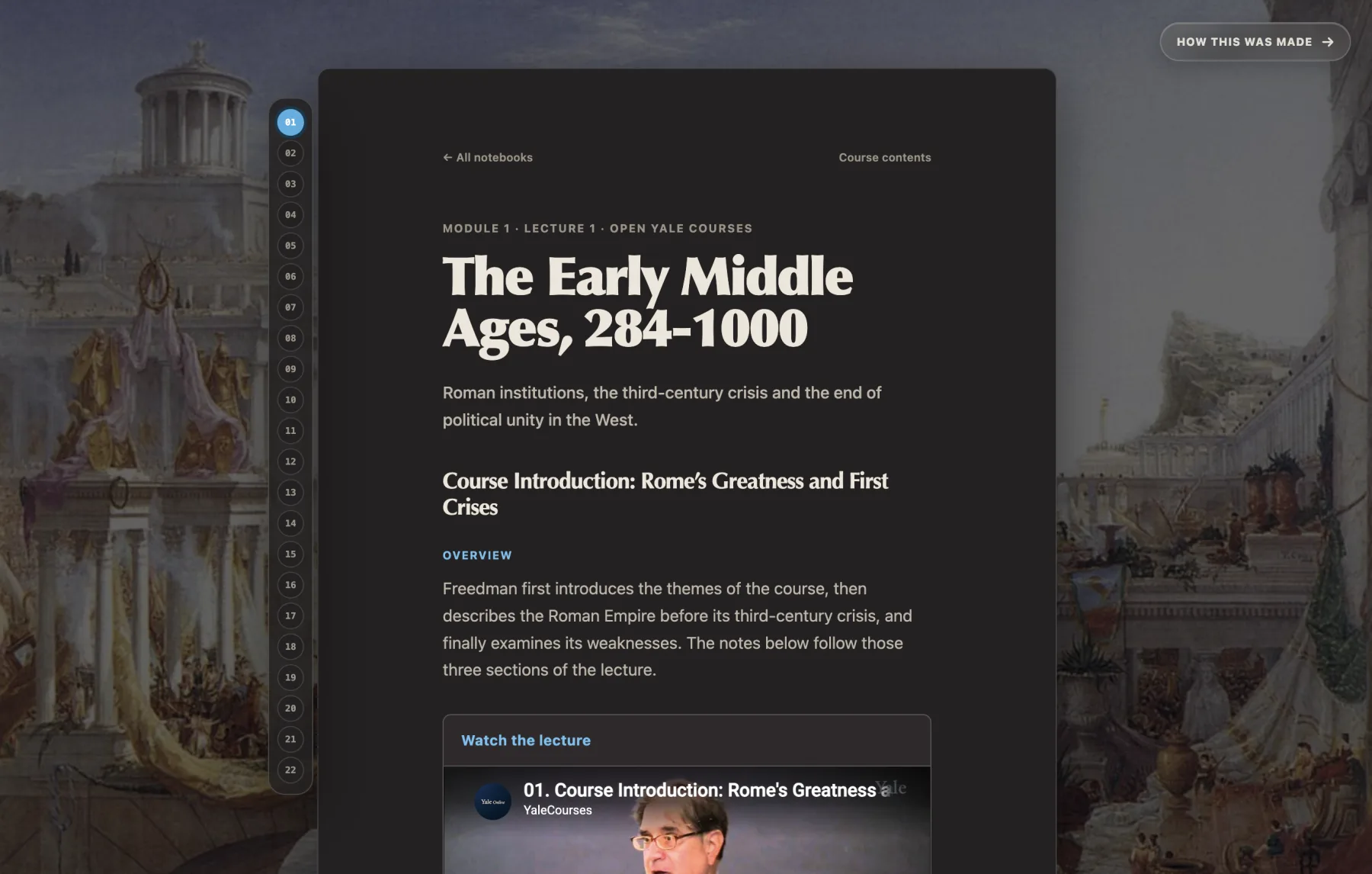
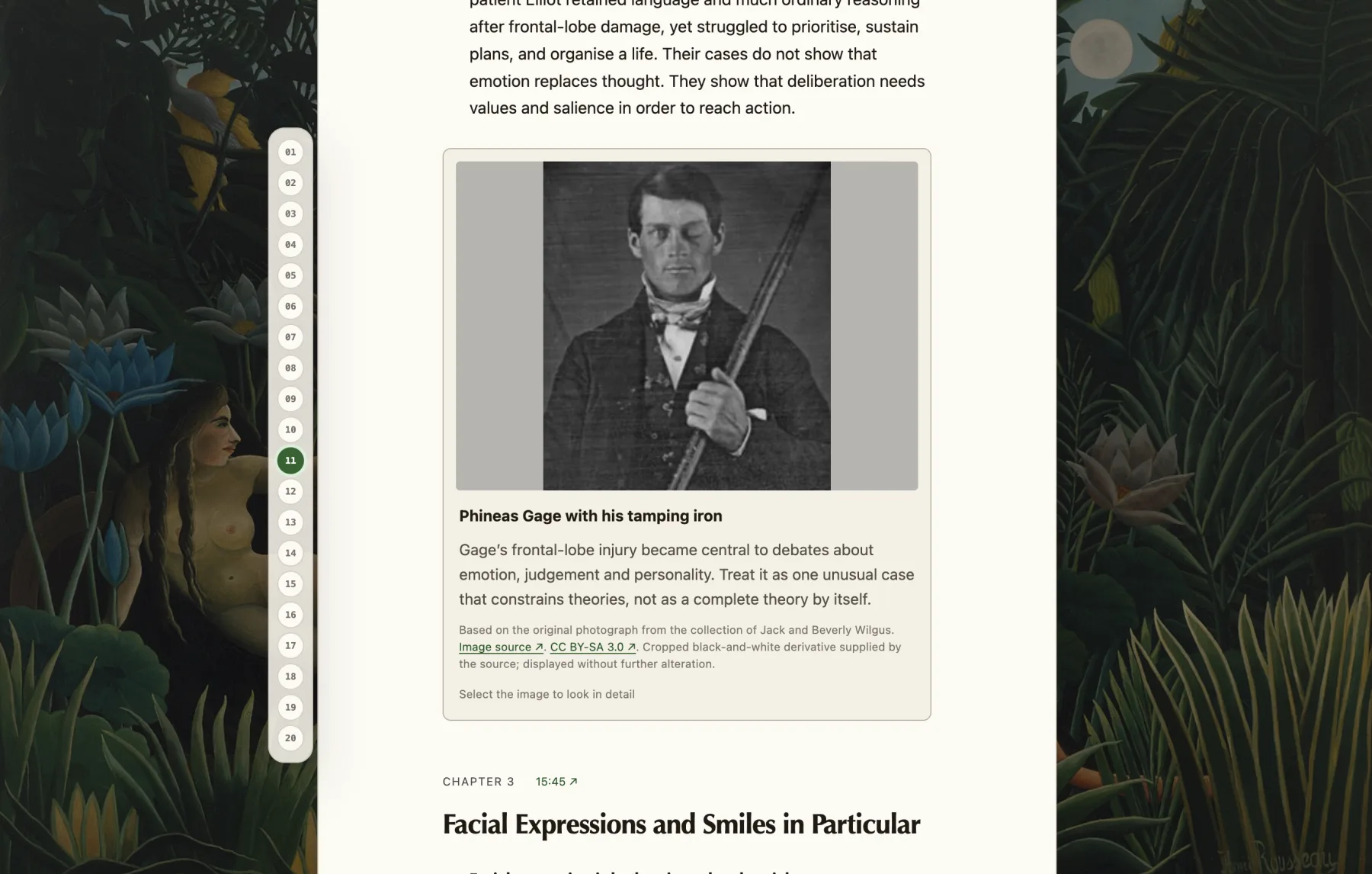
Open Yale Course Notebooks
A free website I designed and built around four public Yale lecture series, plus an open-source Codex skill that turns verified course sources into the same notebook format.
Why I made this project
When I was 20, I enrolled in university in Dublin, Ireland.
I’m French, and at the time my English wasn’t very good. So, being the genius I was, I enrolled in an Irish history course. Now, I knew nothing about Irish history. I had no cultural or historical background to fall back on: everything I knew was French. Obviously, after the first few lectures, I was completely overwhelmed.
Because I could access the slides in advance, I started making documents before each lecture. I used them to give myself the context I was missing and understand what the lecture was going to be about. They helped me follow the course (and pass it!!!!) even when my English was still shaky.
Happy ending.
Now, I’m no longer at university, but I still love learning.
And the wonderful world of the internet is full of complete, free courses from some of the world’s best universities. These days, my English is much better. My concentration, not so much.
So I returned to the same method, with help from AI, and started creating notebooks to accompany some of the Yale courses I was taking. I’ve brought them together on a free website.
https://notebooks.mariedrouvin.com/
Each notebook is designed to help me (and you now) understand the context before you watch a lecture, then remember what you have just watched afterwards. It does NOT replace the course. It is here to guide you through these wonderful lectures, all freely available online.
The notebooks were made with AI. I turned the process into a Course Notebook skill so that you can use it to make your own. It was tested on Open Yale Courses, but it is not limited to them. You may need to poke at it, ask it to improve a few things and make the result your own.
I hope you enjoy the notebooks. If you want to see what else I’ve been making during my current vibe-coding phase, you can find it in my portfolio.
How I built this
- Yale course title
- AI checks the Yale page, playlist and transcripts
- The skill creates the content and applies the design
- Course notebook
The first challenge was finding content complete enough to be interesting. I tried MIT OpenCourseWare first, but many of the courses there were incomplete. The first thing I had built was the Course Maker skill, and it was trying to make courses out of material that simply did not contain enough. That is how I landed on the Open Yale lecture series.
The second challenge was finding the right level of detail. The notebooks needed to surface enough information to give me, and eventually anyone following the courses, a broad view of what the course was about and what its main principles were. But they could not simply repeat the videos or replace the lectures.
The useful structure also changes with the subject. Chronology is essential for The Early Middle Ages, but much less important for psychology. At first, I tried to make the skill extract first principles. That did not really work for history, and it drowned out a lot of the interesting details in psychology.
Eventually, I realised that the instructor had already done that work for me. All I really needed to do was follow the structure of the lectures and extract their topics and subtopics. That became the structure of the notebooks.
I had a much clearer idea of the design because I was already playing with my own website and thinking about rebuilding more of my courses on my own platform. I wanted the notebooks to be beautiful to look at, easy to read, and comfortable on an iPad or any tablet-sized screen.
What comes next
The goal is to add more courses. I’ll admit that, so far, this is still a personal project, so I’m primarily following my own interests.
I also want to keep testing the Course Notebook skill on other platforms and other types of content. I think the method can travel much further than Yale.